Your journey begins in Dunedin, New Zealand, then sails south to the Subantarctic Islands, including the Auckland Islands and Campbell Island, home to rare penguins, albatross, and sea lions. You continue to Macquarie Island, a wildlife haven of penguins, seals, and seabirds, before crossing into Antarctic waters to explore the Ross Sea with possible visits to the Ross Ice Shelf, Franklin Island, McMurdo Sound, Cape Washington, Cape Hallett, and Cape Adare. Sailing west past the Amundsen and Bellingshausen Seas, you reach the Antarctic Peninsula for landings, Zodiac cruises, and wildlife encounters, then visit the South Shetland Islands before crossing the Drake Passage to finish in Ushuaia, Argentina.

Aurora Expeditions
Antártica épica: atravessando o 7º continente
- Partida
- 7 jan 2027
- Retorno
- 7 fev 2027
- Duração
- 32 dias
- Embarque
- Dunedin
- Desembarque
- Ushuaia
- Navio
- Greg Mortimer
Atividades oferecidas
- Caiaque / remo
A partir de US$ 45.895US$ 41.306 por pessoa
Mais informações
Detalhes da viagem
Mapa da viagem⌄

Dia a dia, roteiro da viagem⌄
Day 1 - Arrive Dunedin
![]() Days 4-6 - New Zealand’s Subantarctic Islands
![]() Day 7 - At Sea
![]() Days 10-12 - At Sea
![]() Days 13-18 - Ross Sea
![]() Days 19-26 - Expedition Cruising, Cross the International Date Line
![]() Days 27-31 - Antarctic Peninsula
![]() Days 32-33 - At Sea
![]() Day 34 - Disembark in Ushuaia
Arrive in Dunedin, where you will be met by a representative of Aurora Expeditions and transferred with your fellow expeditioners to your assigned pre-voyage hotel. If you are already in Dunedin, we ask you to make your way to your hotel. This afternoon, visit the Aurora Expeditions hospitality desk in the lobby to collect your luggage tags. Please clearly label the tags with your name and ship cabin number. Our team will confirm details regarding your embarkation day, answer any questions and provide you with information on where to dine or purchase last minute items.
That evening, you may like to indulge in a meal at one of Dunedin’s fine restaurants, or perhaps enjoy a leisurely stroll along the picturesque Otago harbour.
Hospedagem designada: Scenic Hotel Dunedin City
Day 2 - EmbarkationThis morning, enjoy breakfast and check-out. Please ensure your cabin luggage is fitted with cabin tags clearly labelled with your name and cabin number. By 11.00 am, take your cabin luggage to hotel reception, prior to, or at check-out. Your luggage will be stored and transferred directly to the port for clearance, to be placed in your cabin ahead of your arrival on board. Please keep any valuables or personal items with you throughout the day.
A manhã é livre para você explorar Dunedin.
Settle into your cabin, where each detail was designed with your comfort in mind. This luxurious vessel is yours to explore! As we throw the lines and set sail, join your expedition team on deck before tucking into a delicious dinner, and toast to the voyage ahead.
Day 3 - At SeaOn an expedition such as this, the journey is as significant as the destination. Sea days are a wonderful opportunity to relax, meet your fellow travellers and learn about the history, environment and local wildlife in this fascinating corner of the globe.
As you acclimatise to life on board, your expedition team is available to answer any questions you may have and offer pro-tips on photography and birdwatching. With decades of collective experience in the region, they love to share their expertise and enthusiasm with fellow travellers. Join them in the lecture room for entertaining talks and presentations to enrich your understanding of the wildlife, landscapes and historic sites we hope to encounter.
You may like to pamper yourself with a sauna, a visit to the Wellness Centre, or work out at the onboard gym. While away the hours spotting seabirds on deck, curl up with a book in our well-equipped polar library, or chat with your fellow expeditioners at the bar.
First visited by Māori navigators centuries ago, these islands are of great significance to Ngāi Tahu, the indigenous peoples of New Zealand’s South Island. Their natural beauty and astonishing biodiversity have now been recognised globally, but few have had the privilege to visit these far-flung shores, which are now yours to explore.
Ilhas Auckland (Maungahuka / Motu Maha)
Born of fire, scoured by ancient glaciers and shaped by the fierce hand of the Southern Ocean, there is an exquisite ruggedness to this group of weather-worn islands. This apparent bleakness belies the extraordinary abundance of life that thrives here. Roughly half of the world’s yellow-eyed penguins (hoiho), most of the world’s white-capped mollymawks, and the entire population of Auckland Islands wandering albatross find shelter on these shores.
Embrace the spirit of exploration as your expedition team designs your voyage from day to day, bringing decades of experience to selecting ideal sites based on the prevailing conditions and wildlife opportunities.
Alguns lugares que podemos visitar:
Sandy Bay
Sandy Bay is home to a breeding colony of rare New Zealand (Hooker’s) sea lions and an enchanting rātā forest where yellow-eyed penguins (hoiho) make their nests.
Carnley Harbour, Erlangen Clearing
Carnley Harbour offers superb Zodiac cruising through a landscape rich in human history. In 1864, five men became stranded here after their schooner, the Grafton, was wrecked, putting a sudden end to their sealing and tin prospecting ambitions. We hope to see the skeletal remnants of the Grafton, and the moss-covered remains of the Epigwaitt Hut, where they sheltered for 20 months.
Passagem Victoria
Victoria Passage is a lively channel separating Auckland Island from the mountainous Adams Island to the south. We may Zodiac cruise these scenic waters, watching for sooty shearwaters, penguins and sea-lions frolicking in the pure waters.
Ilha Campbell (Motu Ihupuku)
Wind and weather permitting, we will Zodiac cruise sheltered harbours and coves in search of Campbell Island snipes and teals, yellow-eyed penguins (hoiho), and New Zealand (Hooker’s) sea lions (whakahao).
We hope to land at Beeman Cove, Perseverance Harbour, where an old meteorological station stands vigil on the windswept shoreline. Follow a boardwalk through tussock and upland tundra, then enter an otherworldly landscape where large-leaved megaherbs abound. Wonder at the Ross Lily, Campbell Island Daisy and Campbell Island carrot, whose brilliant flowers would look more at home in the tropics than these southern climes. Continue towards the nesting grounds of majestic southern royal albatross, whose wingspans can exceed three metres (10 feet). It is truly humbling to be in the presence of these great wanderers of the southern seas. Find a spot to quietly observe these marvellous birds as they go about their daily duties, undisturbed by their human visitors.
As Campbell Island slips over the horizon, keep watch for Campbell, Salvins and white-capped albatross, which may follow the ship to bid us farewell as we continue south.
Join your expedition team in the lecture room to hear about the fascinating human history of Macquarie Island, and how to identify the unique and charismatic creatures we hope to see in the coming days.
Days 8-9 - Macquarie Island“Penguins were in thousands on the uprising cliffs, and from rookeries near and far came an incessant din . . . seabirds of many varieties gave warning of our near approach to their nests” Douglas Mawson, 1911.
As they sailed towards Antarctica, Mawson and his men encountered ‘an exquisite scene’. Macquarie Island (known affectionately as Macca) rises steeply from the Southern Ocean in a series of emerald summits: a beautifully fierce, elemental landscape teeming with life.
Keep your binoculars handy because this subantarctic refuge is home to 3.5 million breeding seabirds, including no less than four species of penguin! Alongside boisterous colonies of tuxedoed kings, charming gentoos, robust rockhoppers and endemic royal penguins, you’ll find three types of fur seals and a large proportion of the world’s elephant seals. Layer up and head out on deck to experience the sound, sight (and smell!) as you approach one of the largest concentrations of life in the Southern Ocean.
Remember to keep an eye out for Macca’s kelp forests—these remarkable underwater ecosystems are quite mesmerising as their fronds sway back and forth on the water’s surface.
In addition to being a globally recognised and protected wildlife refuge, Macquarie Island played an important role in Antarctic history. It was here, in 1911, that five men disembarked Mawson’s Aurora and established a radio relay station which would transmit the first communication from Antarctica to the outside world.
As Macquarie Island slips over the horizon, keep watch for wandering, grey-headed, black-browed and light-mantled albatross, which may follow the ship to bid you farewell as you continue south.
Close observers may notice a subtle change in the character of the sea as we cross the Antarctic Convergence. Beyond this belt where the waters of the north and south mix, the sea surface temperature drops by about 4°C (39°F), signalling our entry into the Antarctic. This transition zone is known for its nutrient-rich waters, so keep watch for porpoising penguins, flocks of fluttering Antarctic petrels, or perhaps the more solitary snow petrel. You’re not far from the Antarctic Circle, so your first iceberg can’t be far away!
Sea days are a great opportunity for some R & R as you digest your subantarctic experiences and prepare for the next phase of your voyage. Relax and unwind your way, perhaps meeting newfound friends at the bar, treating yourself to a sauna, or editing some images in the comfort of your cabin. And join your expedition team in the lecture room for presentations on the charismatic wildlife and extraordinary adventures that took place along the epic Antarctic coastline you are about to experience.
It’s almost impossible to describe the feeling of arriving in this storied, ice-bound sector of Antarctica. Stepping outside and taking a deep breath of some of the most fresh, crisp air on earth is an experience to cherish forever.
The Ross Sea region is a globally significant wildlife sanctuary. Its nutrient-rich waters support an astonishing array of uniquely adapted Antarctic species, including Ross Sea orcas, Antarctic petrels and South Pacific Weddell seals. It is also home to Antarctica’s largest Adélie penguin colony, and many of the largest emperor penguin colonies. The unique biodiversity of the Ross Sea has been protected within the world’s largest marine protected area since 2016.
The human heritage of the Ross Sea coast is equally impressive. Since James Clark Ross discovered the region in 1841, countless expeditions have built base camps on scattered ice-free slivers of land, using them as staging posts for bold forays across the polar plateau. Many of them departed in a hurry, leaving artefacts, scientific equipment and sometimes entire huts behind. Today these sites are preserved as open-air museums and protected under the Antarctic Treaty System.
Embrace the spirit of exploration as your expedition team designs your voyage from day to day, bringing decades of experience to selecting the ideal sites based on the prevailing weather, ice conditions and wildlife opportunities.
Alguns lugares que podemos visitar:
Plataforma de Gelo Ross
Find a spot on deck as we cruise perfectly cleaved ice cliffs towering some 30 metres above the crystalline waters of the Ross Sea. This is the floating edge of the largest ice shelf in Antarctica, which covers an area the size of France. Watch for elegant emperor penguins, sweet-faced Weddell seals hauled out on ice floes, and the unmistakable ‘pouf’ of an orca’s exhalation.
Ilha Franklin
This delightful ice-free outpost with a rookery of rambunctious Adélie penguins is well worth a visit. Stretch your legs as you stroll up a gentle incline past the colony to a high point, where panoramic views of the Ross archipelago and the ice shelf unfurl.
Estreito de McMurdo
Enter a realm of exquisite beauty, an otherworldly icescape set against a backdrop of gleaming glaciers, shimmering mountains, and the polar ice sheet itself. McMurdo Sound is the historic gateway to the South Pole and remains a busy working harbour today, serving as a logistics hub for the extensive scientific operations taking place at the McMurdo and Scott Research bases on Ross Island.
It is here, in this achingly barren landscape, that early explorers established their base camps and struck out for the South Pole. If conditions allow, we aim to land at one (or more) of their beautifully preserved huts, many of which still stand, to dwell for a moment amongst the artefacts of a distant time, and reflect on the triumphs and tragedies of those who brought them here.
Cabo Washington, Baía Terra Nova
Bounded by soaring peaks and fed by immense glaciers, Terra Nova Bay supports an abundance of polar wildlife, including the rarely sighted Arnoux's Beaked Whale. Fast ice anchored to the bay’s northern shore in the shelter of Cape Washington is home to one of the largest known emperor penguin colonies. Some 20,000 males huddle here each winter, incubating their eggs and awaiting the sun’s return. Weather and ice permitting, visit the bustling rookery to witness the delightful emperors and their fledging chicks.
Cabo Hallett
The snow-capped Admiralty Mountains rise dramatically from the gravelly spit of Cape Hallett, where we hope to land. This is the site of a decommissioned scientific base and an abundance of Antarctic mosses, lichens and invertebrates, protected by the Antarctic Treaty System.
Amble across gently undulating terrain, taking care to give resting Weddell seals a wide berth. The Adélie penguin rookery here can host close to 50,000 breeding pairs, while snow petrels, Wilson’s storm petrels and South Polar skuas breed in the rocky crevices nearby.
Cape Hallett also has a special significance for Aurora. It was from this rocky foothold that Greg Mortimer, co-founder of Aurora Expeditions, launched the Australian Bicentennial Antarctic Expedition in 1988. Cape Hallett provided access to the glaciated coastal ranges beyond, where the six-man team completed the first ascent of Mt Minto (4,165 metres).
Cabo Adare
Cape Adare lies 100 km (62 miles) north of Cape Hallet, at the western entrance to the Ross Sea. A rare ice-free refuge on this icebound coastline, Cape Adare is home to Antarctica’s largest Adélie penguin colony. Ice and weather permitting, wend your way through the pack ice to land on the flat, cobbled spit where more than 250,000 breeding pairs of Adélies gather to busily breed, feed and raise their chicks in the short southern summer.
First visited by James Clark Ross in 1841, this rocky promontory played an important role in the pioneering expeditions of the Heroic Age of Antarctic exploration. It was here in 1899 that the Southern Cross expedition, led by Carsten Borchgrevink, became the first to winter over in Antarctica and establish the first human structures on the continent.
The remnants of these pioneering constructions, and thousands of artefacts scattered in their vicinity, remain virtually untouched and protected under the Antarctic Treaty System. We hope to enter Borchgrevink’s living quarters to experience the awe and imagine the perils of conducting science here, as they did, through an Antarctic winter.
As you reach the halfway mark of your voyage, these days at sea offer time and space to reflect on the emotions and special moments you’ve experienced so far. You may like to make some notes in a journal, reminisce with newfound friends at the bar or start editing a backlog of amazing photos.
For the next week, find your rhythm and settle into life at sea. Your expedition team will offer a daily program of educational activities, entertainment and citizen science programs, which you are welcome to attend. Join them for lectures and daily recaps of your progress, weather and trajectory. Take advantage of the many shared spaces on board: relax in the sauna, work out in the gym or grab a cuppa and peruse the library shelves as the ice shelves guarding the West Antarctic coast slide by.
There is plenty of time to enjoy the magic of the Southern Ocean and the life that calls it home - especially as you gain a day by crossing the international date line! As always, the best place on the ship is out on deck, where Antarctic prions, snow petrels and great whales await - as long as the seas permit!
As you skirt the forbidding ice cliffs guarding the Antarctic ice sheet, spare a thought for British explorer James Cook, whose historic circumnavigation of Antarctica in the late 18th century encountered nothing but treacherous ‘ice islands’ and perilous winds that threatened to blow their wooden sailboat into the sea ice. Cook left the region firm in the belief that no Antarctic continent could exist, and if it did it “that the world will derive no benefit from it”. The search for Antarctica, which had been going for hundreds of years, ground to a halt, only resuming when a merchant sailor named William Smith chanced upon the South Shetland Islands in 1819. This discovery sparked visits from the sealers, whalers and scientists who would define the earliest eras of Antarctic exploration.
A viagem segue para oeste, passando pelos mares de Amundsen e Bellingshausen, rumo ao extremo sul da Península Antártica.
While on the Peninsula we generally make landings or Zodiac excursions twice a day. Rug up and join a Zodiac cruise to view spectacular ice cliffs or explore grounded icebergs, keeping an eye out for whales, seals and penguins, which frequently travel and feed in these waters. Zodiacs will also transport you from the ship to land, where you can visit penguin rookeries, discover historic sites and explore some of our favourite spots along the Peninsula.
While ashore we aim to stretch our legs, wandering along pebbly beaches or perhaps up snow-covered ridgelines to vantage points with mountains towering overhead and ice-speckled oceans below. If you have chosen an optional activity, you will have the option to do that whenever conditions allow, and of course keen polar plungers will have the chance to fully immerse themselves in polar waters - conditions permitting!
In addition to Zodiac cruises and shore excursions, we may ship cruise some of the narrow, dramatic straits separating offshore islands from the mainland, or linger in scenic bays to marvel at sculptural icebergs and photograph spectacular scenery. This is a great time to enjoy panoramic views from the observation lounge or make your way to the bridge (open at the Captain’s discretion) for uninterrupted views of Antarctica in all its splendour. Keep an ear out for the creak and deep rumble of glaciers as they break off, calving into the sea. Take a quiet moment to experience the wonder of this incredible white continent.
The South Shetland Islands is a volcanic island group around a day’s sail from the Antarctic Peninsula. We aim to land or Zodiac cruise at one of the many appealing coves, bays and beaches, with the opportunity to see chinstrap and gentoo penguin colonies, fur and elephant seals, and the historic remnants of the sealing and whaling age.
À tarde, comece a travessia para o norte pela Passagem de Drake.
As your journey draws to a close, take some time to reflect on the experiences of the past few weeks. Perhaps you’d like to organise your photos, jot some more notes in your journal or simply relax and soak up the ambiance on board as you farewell your travel mates . . . until next time!
We hope you become ambassadors for the great Southern Ocean, advocating for its conservation and preservation, and share your experiences with your loved ones, so they might visit and become ambassadors themselves.
No início da manhã, subimos o Canal de Beagle antes de atracar tranquilamente em Ushuaia, onde você pode desembarcar por volta das 8h. Despeça-se da equipe de expedição e dos outros passageiros enquanto todos seguem viagem, quem sabe com uma nova percepção do imenso poder da natureza.
Upon disembarkation, for those continuing their travels in the region, transportation to the hotel will be arranged exclusively for guests who have booked their accommodations through Aurora or for those staying in downtown areas near the port. Expeditioners departing on flights prior to 12:30 pm will be directly transferred to Ushuaia Airport, those with flights after 12:30 pm will have the opportunity to explore Ushuaia before an afternoon airport transfer, and the transfer procedures and details will be communicated onboard before disembarkation.
Observação: ao fim da viagem, não recomendamos reservar voos saindo de Ushuaia antes das 12h00 no dia do desembarque, caso haja atrasos.
O que está incluído e o que não está⌄
INCLUÍDO NA EXPEDIÇÃO
- Todos os traslados de aeroporto mencionados no itinerário.
- Uma noite de hotel com café da manhã em Dunedin no Dia 1.
- Hospedagem a bordo durante a viagem, com arrumação diária da cabine.
- Todas as refeições, lanches, chá, café, refrigerantes e sucos durante a viagem.
- Cerveja e vinho da casa no jantar.
- Recepção de despedida do capitão, com jantar de quatro pratos, coquetéis da casa, cerveja e vinho da casa e bebidas não alcoólicas.
- Todas as excursões em terra e passeios de Zodiac.
- Palestras educativas e serviços de guia prestados pela equipe de expedição.
- Acesso gratuito ao médico de expedição e à clínica médica de bordo (consulta inicial).
- Uma jaqueta de expedição polar impermeável 3 em 1.
- Uso gratuito de botas Muck Boots durante a viagem.
- Informações completas antes da partida.
- Sobretaxas portuárias, licenças e taxas de desembarque.
• Wi-Fi*.
* Observe que viajamos para regiões remotas e, por isso, a conexão pode ser instável.
NÃO INCLUÍDO NA EXPEDIÇÃO
- Voos internacionais ou domésticos, a menos que especificados no itinerário.
- Traslados, a menos que especificados no itinerário.
- Taxas aeroportuárias de chegada ou partida.
- Taxas e custos de passaporte, visto, reciprocidade e vacinação.
- Seguro viagem ou custos de evacuação de emergência.
- Hospedagem em hotel e refeições, salvo indicação diferente no itinerário.
- Excursões opcionais e sobretaxas de atividades opcionais.
- Todos os itens de natureza pessoal, incluindo, entre outros, bebidas alcoólicas (fora do serviço de jantar), gorjetas, lavanderia, roupas pessoais, despesas médicas ou ligações telefônicas.
Note: A $15 USD per person per day gratuity for the crew is automatically added to your onboard account. It is at your discretion if you would like to remove the tip (or adjust the amount) when you settle your bill. It is not necessary to tip the expedition team members. This gratuity amount is included for suites as part of their ‘Suite Benefits’
Condições de pagamento⌄
É exigido um sinal não reembolsável de US$ 2.500 por pessoa em até 7 dias úteis após a reserva. O pagamento final deve ser feito pelo menos 90 dias antes da data de partida da expedição
Preços por pessoa
Cabines
Os preços são definidos pelas operadoras e mudam com a procura, às vezes de um dia para o outro. Valores em dólar, por pessoa.
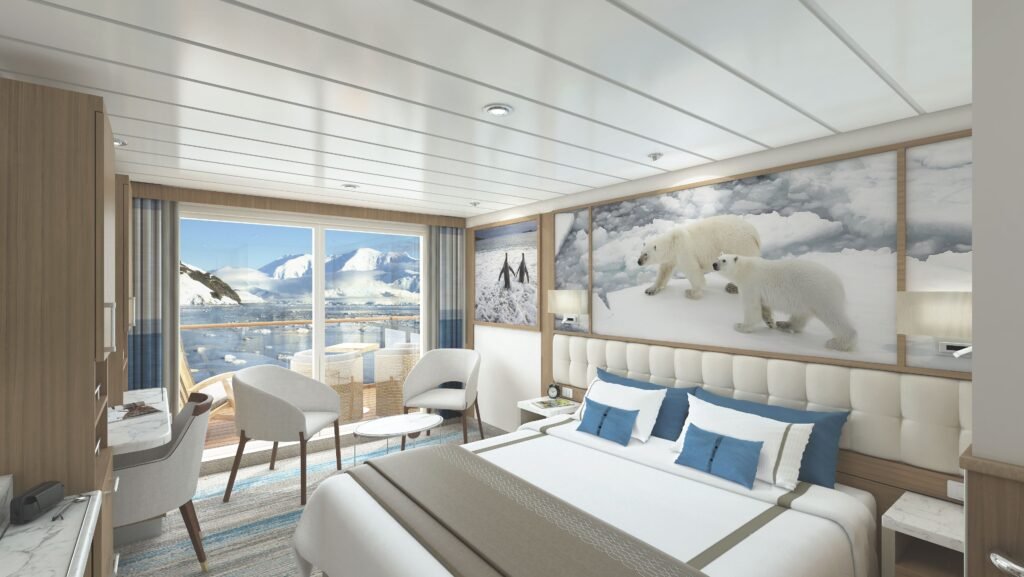
Cabine com varanda categoria A
Our 23 Balcony Stateroom A rooms are our premium and most abundant option on board. Strategically located in prime positions on Decks 4 and 6, they offer easy access to other levels via internal stairs or the elevator.
Observação: todas as imagens de cabines do Greg Mortimer são ilustrações artísticas, e o projeto final pode variar.
- Pessoas
- 2
- Tamanho
- 24.1m² - 28m² (259.41 ft² - 301.39 ft²)
- Vista
- Varanda privativa
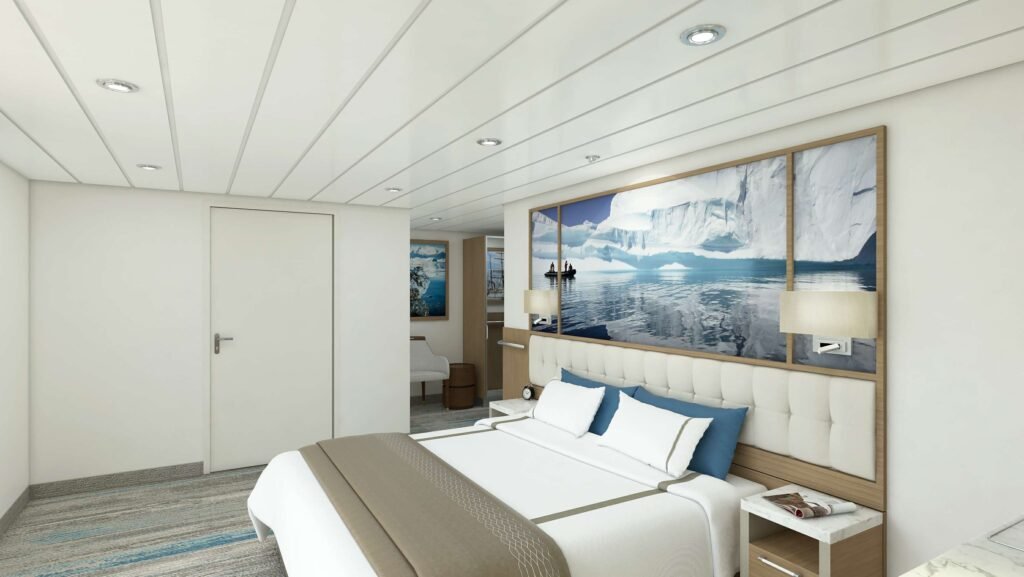
Cabine Superior com varanda
Com espaço extra para relaxar, as Cabines Superiores com varanda são ideais para aventureiros polares que viajam com bastante equipamento.
Localizadas nos decks 4 e 6, estas cabines têm janelas do chão ao teto, banheiro privativo e uma área de trabalho confortável. Algumas cabines também têm banheiro acessível para cadeira de rodas.
Observação: todas as imagens de cabines do Greg Mortimer são ilustrações artísticas, e o projeto final pode variar.
- Pessoas
- 2
- Tamanho
- 28.2m² - 40.2m² (303.54 ft² - 432.70 ft²)
- Vista
- Varanda privativa
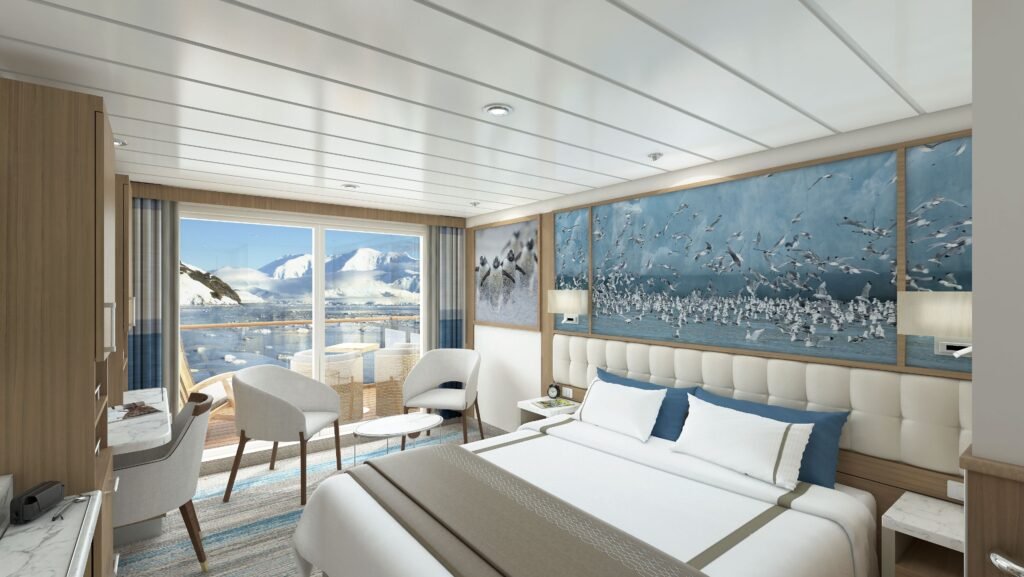
Cabine com varanda categoria C, Individual
Our two Balcony Stateroom C - Solo rooms are the most budget-friendly option, equipped with essential amenities and conveniently located across Deck 6.
Observação: todas as imagens de cabines do Greg Mortimer são ilustrações artísticas, e o projeto final pode variar.
- Pessoas
- 1
- Tamanho
- 20.9m² - 24.8m² (224.97 ft² - 266.95 ft²)
- Vista
- Varanda privativa
Esgotada
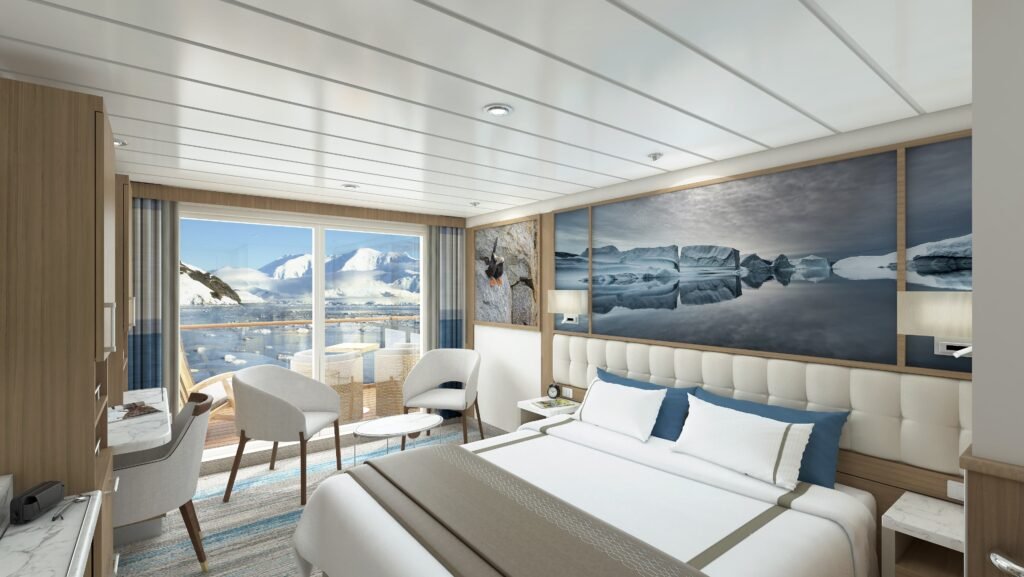
Cabine com varanda categoria B, Individual
Nossas duas Cabines com varanda B - Individual são a opção padrão, localizadas na parte da frente do Deck 6.
Observação: todas as imagens de cabines do Greg Mortimer são ilustrações artísticas, e o projeto final pode variar.
- Pessoas
- 1
- Tamanho
- 23.6m² - 24.8m² (254.03 ft² - 266.95 ft²)
- Vista
- Varanda privativa
Esgotada

Cabine com varanda categoria A, Individual
Our six Balcony Stateroom A - Solo rooms are our premium and most abundant solo option on board. Strategically located in prime spots on Decks 4 and 6, they offer easy access to other levels via internal stairs or the elevator.
Observação: todas as imagens de cabines do Greg Mortimer são ilustrações artísticas, e o projeto final pode variar.
- Pessoas
- 1
- Tamanho
- 24.1m² - 28m² (259.41 ft² - 301.39 ft²)
- Vista
- Varanda privativa
Esgotada
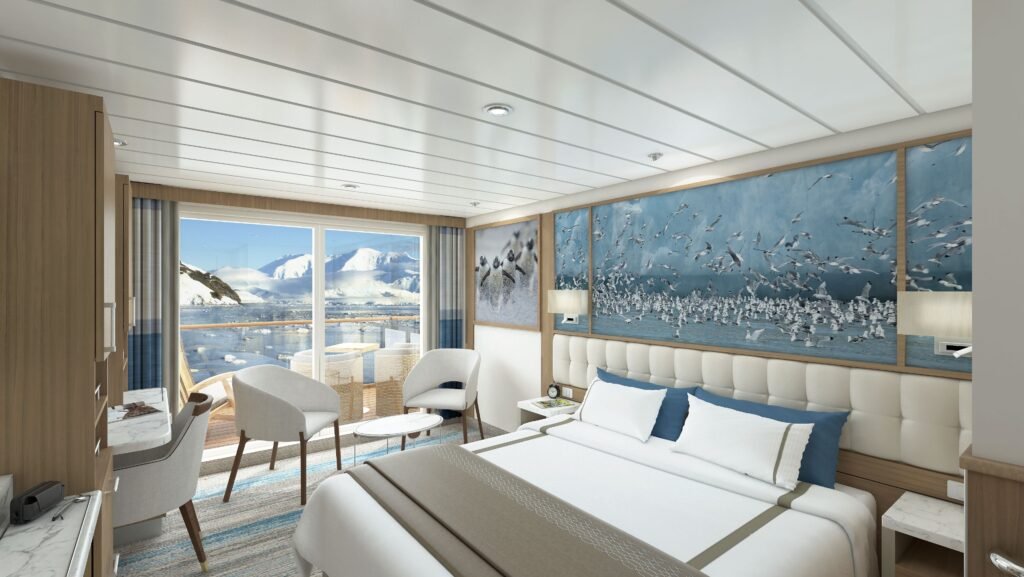
Cabine com varanda categoria C
Our 14 Balcony Stateroom C rooms are the most budget-friendly option, equipped with essential amenities and comfortably accommodating up to two guests. These staterooms are conveniently located across Decks 4 and 6.
Observação: todas as imagens de cabines do Greg Mortimer são ilustrações artísticas, e o projeto final pode variar.
- Pessoas
- 2
- Tamanho
- 20.9m² - 24.8m² (224.97 ft² - 266.95 ft²)
- Vista
- Varanda privativa
Esgotada
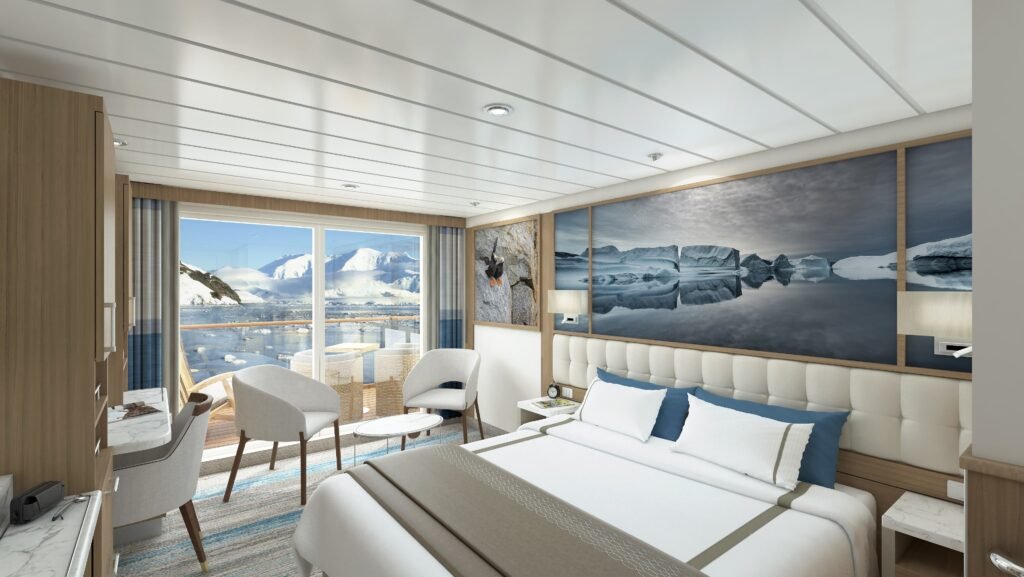
Cabine com varanda categoria B
Our 21 Balcony Stateroom B rooms are our standard option, with many featuring interconnecting doors—ideal for families or groups. These staterooms are located at the front and rear of Decks 4 and 6.
Observação: todas as imagens de cabines do Greg Mortimer são ilustrações artísticas, e o projeto final pode variar.
- Pessoas
- 2
- Tamanho
- 23.6m² - 24.8m² (254.03 ft² - 266.95 ft²)
- Vista
- Varanda privativa
Esgotada

Suíte Júnior
Perched on Deck 7, the Greg Mortimer's four Junior Suites offer stunning views. When not out exploring, unwind in the private lounge area or take in the scenery from your own balcony.
Observação: todas as imagens de cabines do Greg Mortimer são ilustrações artísticas, e o projeto final pode variar.
- Pessoas
- 2
- Tamanho
- 38.9m² (418.71 ft²)
- Vista
- Varanda privativa
Esgotada
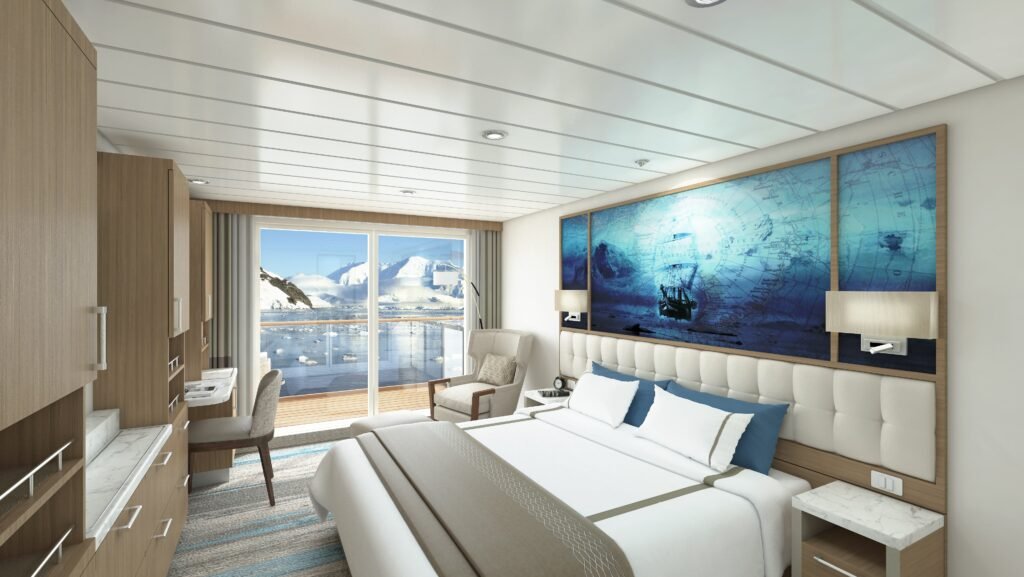
Suíte do Capitão
The Greg Mortimer’s exclusive Captain’s Suite is the largest and most luxurious room on board, offering the ultimate in style and comfort for your polar adventure. Featuring a spacious lounge area, private balcony, walk-in wardrobe, and en-suite, this suite is in high demand—so be sure to book early.
Observação: todas as imagens de cabines do Greg Mortimer são ilustrações artísticas, e o projeto final pode variar.
- Pessoas
- 2
- Tamanho
- 44.5m² (478.99 ft²)
- Vista
- Varanda privativa
Esgotada
Opcionais
Atividades de aventura
Caiaque no mar
US$ 1.745 por pessoa
Sea kayaking in the wilds of Antarctica, the Arctic, and some of the world’s most biodiverse regions offers an exhilarating way to explore stunning coastlines and icebergs. Designed by kayakers for kayakers, this program allows you to develop your skills, connect with expert guides, and maximize time on the water. In small groups of up to 10 paddlers, you’ll explore hidden bays and shores inaccessible to Zodiacs, with outings ranging from 5 to 15 kilometers (2–4 hours). Whether kayaking or onshore, you’ll experience the incredible landscapes and wildlife up close. With provided gear and professional guidance, you’ll enjoy a safe, thrilling adventure that lets you immerse fully in the environment.

O navio
Greg Mortimer
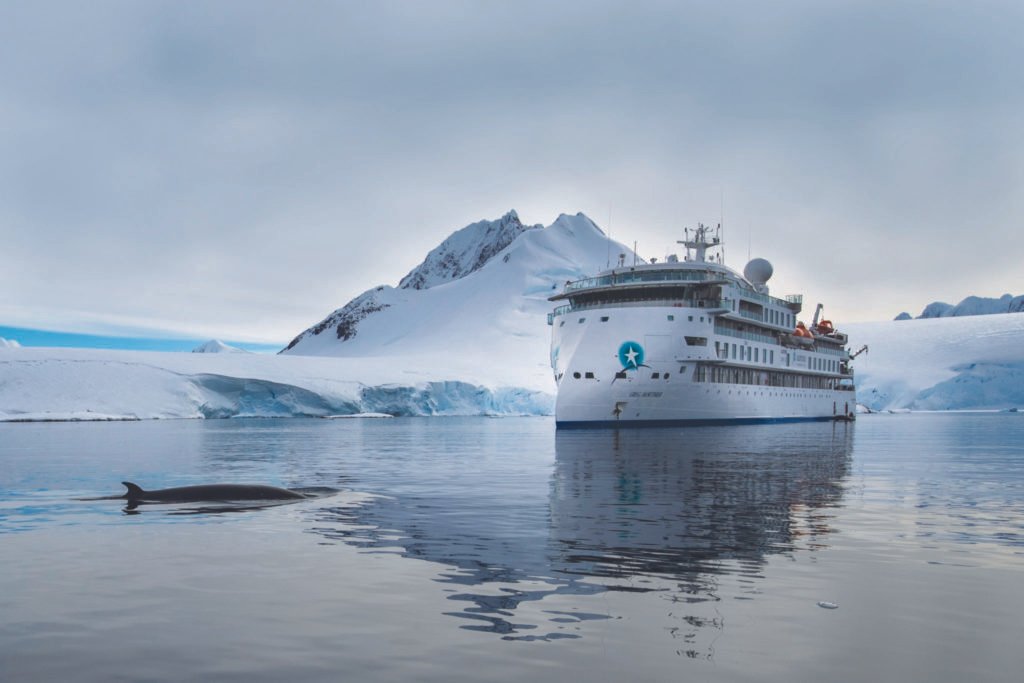
Drawing on centuries of experience, they designed the Greg Mortimer as a purpose-built vessel for exploring the wildest and most remote places on Earth.
As the first passenger ship to feature the revolutionary Ulstein X-BOW®, it crosses oceans more smoothly and efficiently. Expansive observation decks bring travelers closer to nature, while inviting communal spaces and industry-leading environmental credentials make it the perfect base camp for exploration.
Accommodating up to 130 expeditioners per voyage, the ship offers 76 cozy, ocean-view staterooms—85% with private balconies. It also features a modern lecture lounge, multiple observation areas, a restaurant serving excellent meals, a Wellness Centre, gym, sauna, Jacuzzis, a mudroom, and more, ensuring both comfort and adventure at every turn.
Estrutura a bordo
- • Instalações modernas para palestras
- • Refeições
- • Academia, sauna e jacuzzis
- • Biblioteca
- • Sala de botas
- • Bares e lounges
Bom saber
Crossing the notorious Drake Passage or Denmark Strait, their expeditions encounter some of nature’s most intense conditions. The Greg Mortimer, at the forefront of nautical technology, is built to handle the challenge with power, stability, and efficiency.
Ulstein X-BOW®
Used in over 100 commercial vessels, the streamlined Ulstein X-BOW® cuts through the swell for smoother crossings, reducing vibrations and disturbances while improving fuel efficiency. Combined with Rolls Royce dynamic stabilizers, it offers unmatched stability and comfort* on ocean voyages.
*A Aurora Expeditions não afirma que isso vá prevenir ou curar o enjoo.
Acesso eficiente aos Zodiacs
The ship carries 15 Zodiacs, accessible via four dedicated boarding doors for fast, safe, and efficient transfers, minimizing wait times and maximizing time spent exploring.
Plataforma de atividades
From kayaking and diving to climbing and ski touring, the Greg Mortimer supports a range of adventure activities. Spacious preparation and loading areas, designed in consultation with expert guides, make transitioning from ship to sea or shore smooth and efficient. Dedicated lockers and rapid-drying areas ensure wetsuits and dry suits are ready for the next excursion.
Plataformas de observação hidráulicas
In addition to onboard observation areas, the ship features unique hydraulic viewing platforms, designed with Greg Mortimer himself. These fold-out platforms provide unobstructed views of marine life and seabirds during calm cruising or when stationary in favorable weather.
Recursos de viagem responsável
The Greg Mortimer was designed with sustainability in mind, operating with low energy consumption, high fuel efficiency, and a streamlined structure that reduces emissions.
The ship also features virtual anchoring technology, which uses GPS, steering, propellers, and thrusters to hold position without damaging the sea floor with conventional anchors.
Recursos de segurança
Equipped with industry-leading safety technology, the Greg Mortimer exceeds the requirements for a ship of its size. Its world-class return-to-port system duplicates propulsion, allowing continued operation in the event of engine failure.
The ship is Ice Class 1A and Polar Code 6 compliant, holds a BV* classification, and fully meets the latest SOLAS safety requirements. A fully stocked medical clinic ensures the highest level of care, even in remote locations.
Perguntas frequentes
Dúvidas sobre esta viagem
Vamos descer do navio?⌄
Sim!!! Quando a viagem começar, o grande objetivo do Capitão, do Líder da Expedição e da Equipe de Expedição será garantir que a gente saia do navio o máximo possível. Você vai participar de desembarques, passeios de Zodiac e de qualquer atividade extra em que tenha se inscrito. Veja o “Itinerário detalhado da viagem” para mais detalhes sobre cada saída.
Há taxas e encargos adicionais?⌄
O preço mostrado é o preço "tudo incluído”, com todos os impostos, taxas, taxas portuárias e licenças exigidas, que são administrados pela operadora. Os únicos custos adicionais importantes serão o seguro viagem obrigatório, a gorjeta opcional e as atividades adicionais.
Pago mais se viajar sozinho?⌄
Não necessariamente! Nossas viagens em grupo costumam ter cerca de 50% de viajantes sozinhos! Os preços são sempre por pessoa, por cama. Se você viaja sozinho, vamos combinar você com alguém do mesmo gênero do nosso grupo para dividir a cabine. Também existe a opção de cabine individual em algumas viagens. Mande uma mensagem para a gente sobre cabines individuais se essa for sua preferência.
Quer reservar ou tirar uma dúvida?
Fale com a nossa equipe. A gente confirma a disponibilidade com a operadora e responde por email.
Pedir informações desta viagemAntártica épica: atravessando o 7º continente · 7 jan 2027