
Aurora Expeditions
Passagem do Noroeste
- Partida
- 12 set 2028
- Retorno
- 26 set 2028
- Duração
- 15 dias
- Embarque
- Calgary
- Desembarque
- Reykjavík
- Navio
- Sylvia Earle
A partir de US$ 25.495US$ 19.122 por pessoa
Mais informações
Detalhes da viagem
Mapa da viagem⌄
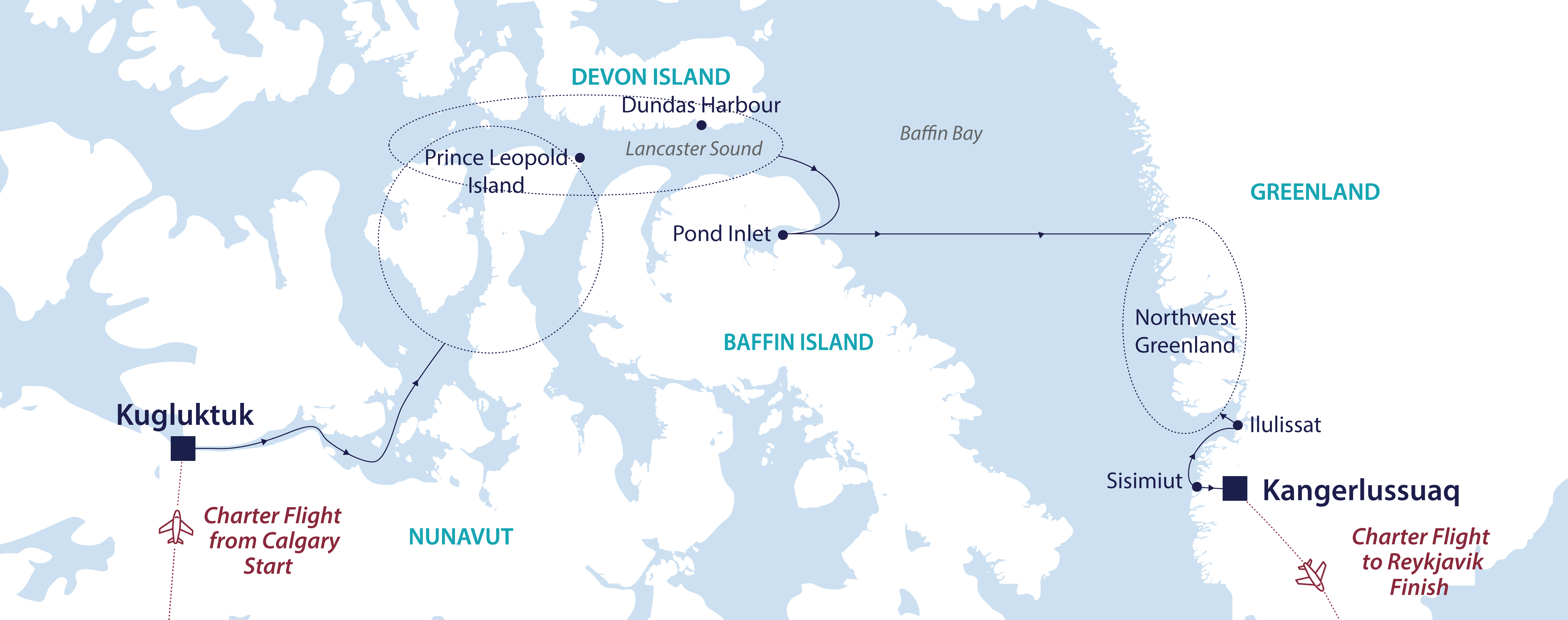
Welcome to Aurora Expeditions’ Northwest Passage expedition. Journey east from the western Canadian Arctic to Greenland on a late-season expedition through the Northwest Passage. Inuit history provides the essential thread: from the copper-working traditions of the Inuinnait and the oral knowledge that helped reveal the fate of Franklin’s ships, to Greenlandic communities whose lives remain closely connected to ice, sea and wildlife. Explore sites associated with European polar ambition, including King William Island and the storied waters of Bellot Strait, while watching for polar bears, walrus, musk oxen, seals, whales and the returning northern lights. Every day is shaped by weather, sea ice and opportunity.
Dia a dia, roteiro da viagem⌄
Dia 1 Chegada a Calgary
On arrival in Calgary, you will be met by an Aurora Expeditions representative and transferred to the group hotel. Visit the Aurora Expeditions hospitality desk to collect your cabin luggage tags and speak with our ground operations team. They will share important pre-embarkation information for tomorrow’s charter flight and can assist with local dining suggestions or last-minute purchases.
O resto do dia é livre para você aproveitar. Todas as refeições de hoje ficam por sua conta.
Hospedagem: hotel em Calgary (a confirmar).
Dia 2 Voo para Kugluktuk e embarque
Transfer to Calgary Airport and board our charter flight to Kugluktuk, Nunavut. Please ensure your main luggage is fitted with the cabin tags provided and keep valuables, travel documents, medication and anything required during the day in your hand luggage.
Kugluktuk, meaning ‘place of moving water’, stands near the mouth of the Coppermine River in the homeland of the Inuinnait. Copper gathered in this region was fashioned into tools for generations, giving rise to the historical English name ‘Copper Inuit’. Transfer to Sylvia Earle, settle into your cabin and join the mandatory safety briefings before meeting your Expedition Team and crew.
Dia 3 Port Epworth e no mar
We hope to begin with a Zodiac cruise or landing at Port Epworth, on a coast shaped by ancient geology and a long record of Inuit travel and seasonal use. Depending on conditions, we may explore the shoreline and search for archaeological traces that reveal how people moved through and lived within this western Arctic landscape.
Later, we set a course east. Watch from deck for seals, whales and migrating birdlife as the Expedition Team introduces the human and natural history of the Northwest Passage.
Dia 4 Cambridge Bay (Iqaluktuuttiaq) e no mar
Iqaluktuuttiaq, or Cambridge Bay, means ‘place of many fish’ and reflects the rich waters that have long drawn Inuit families to this part of Victoria Island. Today it is a vibrant regional centre where Inuinnaqtun language, harvesting traditions and contemporary northern life meet.
The harbour is also linked with Roald Amundsen’s ship Maud, which remained here for decades after becoming trapped in ice and sinking. A locally guided visit may explore community history and culture before we return to the ship and continue east.
Dia 5 Ilha King William
We aim to explore the western side of King William Island, known to Inuit as Qikiqtaq. This landscape is central to the Franklin story, but its history is far older and richer than the European search for a passage. Inuit travelled, hunted and camped throughout the region for generations, developing knowledge that later proved crucial to understanding the fate of HMS Erebus and HMS Terror.
Weather and sea ice will determine our landing place. On shore, the Expedition Team may interpret archaeological features, expedition relics and the oral histories that connect this coast with one of polar exploration’s most enduring mysteries. We will also watch for caribou, Arctic foxes, seals and polar bears.
Dia 6 Região do Estreito de Bellot
Bellot Strait is one of the most storied waterways of the Northwest Passage. Barely two kilometres wide at its narrowest point, it separates Somerset Island from the Boothia Peninsula and is swept by strong tides and shifting ice. Safe conditions may allow us to transit or explore in the vicinity of Fitzroy Inlet, Bellot Strait or Strzelecki Harbour.
Zodiac cruises and tundra walks reveal an austere landscape of cliffs, coves and tidal channels. This was a formidable obstacle for early navigators, yet part of a well-known homeland and travel network for Inuit. Scan the shore and water for polar bears, seals, beluga and seabirds.
Dia 7 Baía Radstock
At Radstock Bay, beneath the limestone mass of Caswall Tower, archaeological remains reveal generations of Inuit life. Stone house foundations, caches and whale bones speak to sophisticated hunting practices, food storage and seasonal movement through the region. We hope to hike across raised beaches and tundra while our guides bring these traces into context.
Wildlife also shapes our plans. Walrus may use parts of this coast as haul-out habitat, and access can be restricted to protect them. Musk oxen, Arctic hare, foxes and polar bears are also possible in the wider area, so the Expedition Team may select an alternative site on northwestern Somerset Island if required.
Dia 8 Baía Maxwell
Maxwell Bay (Tasiujaq) cuts deeply into Devon Island and offers a choice of sheltered inlets, including Graham Harbour and Custance Inlet. By late September the tundra has taken on autumn tones and early snow may sharpen the island’s flat-topped mountains and glacial valleys.
We may explore by Zodiac or on foot, watching for musk oxen, Arctic hare and foxes on land, and seals or walrus in the water. Polar bears move throughout this region, although every sighting is a matter of chance. Archaeological remains and historic sites may also reveal how Inuit travellers, traders and later government patrols used these protected waters.
Dia 9 Croker Bay e Dundas Harbour
At Croker Bay, a glacier descends towards a broad Arctic inlet. Conditions may favour a Zodiac cruise among sculpted ice or a landing beneath Devon Island’s distinctive mountains. Ringed seals and walrus may be present, with polar bears occasionally travelling the coast.
We also hope to visit Dundas Harbour, where the remains of an RCMP post and former Hudson’s Bay Company activity represent a recent layer of history. Nearby archaeological features point to much older Inuit use of this coast. A tundra walk may bring encounters with musk oxen, Arctic hare and late-season birdlife.
Dia 10 No mar
We leave Nunavut and cross Baffin Bay towards Greenland. Spend time on deck scanning for whale blows, seals and fulmars, or join presentations that connect the two sides of the passage—from shared Inuit cultural roots and long-distance travel to the ambitions of European explorers and the realities of navigation through ice.
Com a volta da escuridão à noite ártica, o céu limpo também pode trazer a chance de ver a aurora boreal.
Dia 11 Kullorsuaq e o Devil’s Thumb
Our return to Greenland begins at Kullorsuaq, a small community set among islands, mountains and ice in the Upernavik Archipelago. The settlement takes its name from the distinctive mountain nearby: Kullorsuaq, or ‘the Big Thumb’, known in English as the Devil’s Thumb.
A community visit may offer insight into life in one of Greenland’s northern settlements, where hunting and fishing remain closely tied to sea ice, weather and seasonal wildlife. Offshore, icebergs drift through intricate channels used by seals and whales, and the surrounding cliffs may hold ravens and seabirds.
Dia 12 No mar e Nuussuaq
A morning at sea allows time to watch the Greenland coast unfold and to learn more about its geology, wildlife and human history. Humpback and minke whales may be encountered in these waters, while changing ice and weather guide our progress.
Later, we hope to explore around Nuussuaq. The peninsula’s immense basalt mountains and broad valleys preserve evidence of ancient movement and settlement along a coast that has supported Inuit communities for thousands of years. A late-day landing may offer a tundra walk, Zodiac cruise or community visit, subject to conditions and local arrangements.
Dia 13 Ilulissat
Today’s plans will be shaped by ice, weather and local conditions. We hope to visit Ilulissat, where people have lived beside the icefjord for more than 4,000 years. A walk towards the UNESCO World Heritage-listed Ilulissat Icefjord reveals a constantly changing procession of bergs calved by Sermeq Kujalleq. The nearby Sermermiut valley preserves traces of successive Inuit cultures and adds a powerful human story to this extraordinary glacial landscape.
Dia 14 Ukivik e Nipisat
At Ukivik, open tundra and an indented coast may offer a final wilderness walk, shaped by weather, wildlife and local conditions.
Later, we hope to visit Nipisat, part of the UNESCO World Heritage property Aasivissuit–Nipisat: Inuit Hunting Ground between Ice and Sea. Archaeological layers document more than 4,000 years of human history and reveal how successive cultures adapted to seasonal resources between the Greenland Ice Sheet and the coast. It is a fitting place to reflect on Inuit resilience, knowledge and continuity at the end of our passage.
Dia 15: Desembarque em Kangerlussuaq e voo para Reykjavík
In Kangerlussuaq, farewell the crew, Expedition Team and fellow travellers before transferring to the airport for our charter flight to Reykjavík. The voyage concludes on arrival at Reykjavík Airport.
Note: Our arrival time in Reykjavík depends on the allocated charter-flight slots, which we expect to receive in March 2028. We recommend allowing flexibility when arranging onward travel.
O que está incluído e o que não está⌄
INCLUSÕES:
- Todos os traslados mencionados no itinerário.
- Uma noite de hotel com café da manhã em Calgary no Dia 1.
- Voo fretado de Calgary para Kugluktuk no Dia 2.
- Voo fretado de Kangerlussuaq para Reykjavík no Dia 15.
- Hospedagem a bordo durante a viagem, com serviço de quarto diário.
- Todas as refeições, lanches, chá, café, refrigerantes e sucos durante a viagem.
- Destilados premium, coquetéis, cerveja, vinho e licores durante a viagem.
- Recepção de despedida do comandante, com jantar de quatro pratos, coquetéis da casa, cerveja e vinho da casa e bebidas não alcoólicas.
- Todas as excursões em terra e passeios de Zodiac.
- Palestras educativas e serviços de guia oferecidos pela equipe de expedição.
- Acesso gratuito ao médico da expedição e à clínica médica a bordo para uma consulta inicial.
- Uma jaqueta polar de expedição 3 em 1 impermeável.
- Uso gratuito de botas Muck Boots durante a viagem.
- Informações completas antes da partida.
- Sobretaxas portuárias, licenças e taxas de desembarque.
- Gorjetas para guias locais, motoristas, locais de visita e atrações durante as excursões e o programa de enriquecimento.
- Wi-Fi*.
* Lembre que viajamos para regiões remotas, onde a conexão pode ser instável.
NÃO INCLUÍDO:
- Voos internacionais ou domésticos, a menos que especificados no itinerário.
- Traslados, a menos que especificados no itinerário.
- Taxas aeroportuárias de chegada ou partida.
- Taxas e custos de passaporte, visto, reciprocidade e vacinação.
- Seguro viagem ou custos de evacuação de emergência.
- Hotéis e refeições – salvo indicação no itinerário.
- Excursões opcionais e sobretaxas de atividades opcionais.
- All items of a personal nature, including but not limited to onboard gratuities*, laundry services, personal clothing, medical expenses, email or phone charges.
*A gratuity of USD $20 per person, per day for the crew and Expedition Team will be automatically added to your onboard account. You may remove or adjust this amount when settling your account. For suite guests, this gratuity is included as part of the Suite Benefits.
Condições de pagamento⌄
Sinal e pagamento
- Sinal: 25% do valor da passagem por pessoa, devido em até 7 dias úteis após a reserva (a reserva só é confirmada depois do recebimento).
- Sinal de atividades (caiaque, mergulho, caminhada com raquetes de neve etc.): US$250 adicionais por pessoa por atividade, reembolsáveis só se a própria atividade for cancelada.
- Pagamento final: devido 120 dias antes da partida. Se a reserva for feita a menos de 120 dias, o pagamento integral é devido na reserva.
Cancelamento pelo passageiro
- 121 dias ou mais antes da partida: perda apenas do sinal.
- 120 dias ou menos antes da partida: 100% do valor total da passagem.
Opção de transferir em vez de cancelar
- 121 dias ou mais antes: o sinal integral pode ser transferido para uma viagem futura (em até 36 meses).
- De 90 a 120 dias antes: 50% do valor total da passagem (não só o sinal) pode ser transferido para frente em vez de perdido.
- Menos de 90 dias antes: transferência não permitida.
- Não há taxa de transferência, e as transferências podem ser usadas várias vezes, desde que cada nova viagem parta em até 36 meses da data original.
Clima / força maior
- Se as condições de clima ou gelo tornarem a viagem insegura, a Aurora pode cancelar e emitir um crédito (não reembolso) do valor total pago, válido para uma viagem futura em até 36 meses. É uma política de crédito em primeiro lugar, e não de reembolso em dinheiro.
Preços por pessoa
Cabines
Os preços são definidos pelas operadoras e mudam com a procura, às vezes de um dia para o outro. Valores em dólar, por pessoa.

Aurora Stateroom Superior
No Deck 7, as cabines têm varandas francesas, janelas do chão ao teto, banheiro privativo e um aconchegante cantinho com escrivaninha.
- Pessoas
- 2
- Tamanho
- 19.9m2 - 20.8m2(214.2ft2 - 223.9ft2)
- Vista
- Varanda francesa

Cabine com varanda categoria C
As nossas 11 Cabines com varanda C são a opção mais econômica, com as comodidades essenciais e espaço confortável para até dois hóspedes. Essas cabines ficam nos Decks 4 e 6, em locais práticos.
- Pessoas
- 2
- Tamanho
- 19.5m² - 28.7m² (209.9ft² - 308.9ft²)
- Vista
- Varanda privativa

Cabine com varanda categoria B
As nossas 17 Cabines com varanda B são a opção padrão, e muitas têm portas de comunicação entre si, perfeitas para famílias ou grupos. Essas cabines ficam na proa e na popa dos Decks 4 e 6.
- Pessoas
- 2
- Tamanho
- 19.5m² - 28.7m² (209.9ft² - 308.9ft²)
- Vista
- Varanda privativa

Cabine com varanda categoria A
As nossas 23 Cabines com varanda A são a opção premium e a mais numerosa a bordo. Bem localizadas em áreas nobres dos Decks 4 e 6, dão acesso fácil aos outros níveis pelas escadas internas ou pelo elevador.
- Pessoas
- 2
- Tamanho
- 19.5m² - 28.7m² (209.9ft² - 308.9ft²)
- Vista
- Varanda privativa

Cabine Superior com varanda
Com espaço extra para relaxar, as Cabines Superiores com varanda são ideais para aventureiros polares que viajam com bastante equipamento.
Localizadas nos decks 4 e 6, estas cabines têm janelas do chão ao teto, banheiro privativo e uma área de trabalho confortável. Algumas cabines também têm banheiro acessível para cadeira de rodas.
- Pessoas
- 2
- Tamanho
- 29.2m² - 35.2m² (314.3ft² - 378.9ft²)
- Vista
- Varanda privativa

Suíte Júnior
No Deck 7, as quatro Suítes Júnior têm vistas deslumbrantes. Quando não estiver explorando, relaxe na sala de estar privativa ou aprecie a paisagem da sua própria varanda.
- Pessoas
- 2
- Tamanho
- 41.6m² (447.8ft²)
- Vista
- Varanda privativa

Suíte do Capitão
A maior e mais luxuosa acomodação a bordo, a Suíte do Capitão combina elegância e conforto na medida para a sua aventura polar. Com uma sala de estar espaçosa, varanda privativa, closet e banheiro privativo, essa suíte exclusiva é o refúgio ideal. Como só existe uma, é essencial reservar com antecedência.
- Pessoas
- 2
- Tamanho
- 43.8m² (471.5 ft²)
- Vista
- Varanda privativa
Opcionais
Atividades de aventura
Caiaque no mar
$ 1,250 USD per person
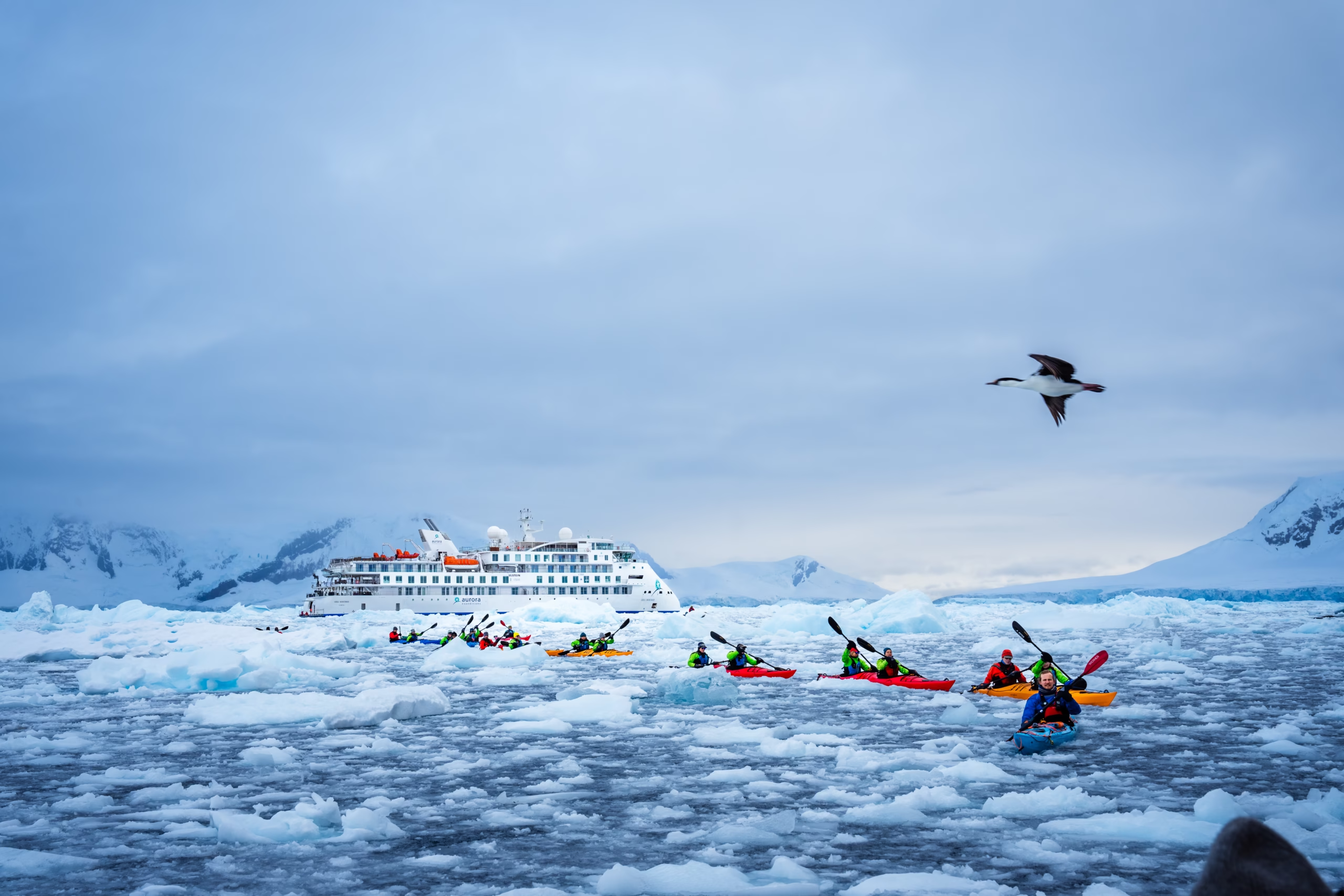
This Kayaking Program was created by kayakers for kayakers! Our program style offers the chance to develop and enhance your skills and to connect with our expert guides and your fellow Expeditioners. Participating with the small group through your voyage will minimise wasted time with briefings and equipment tryouts and maximise time on the water.
All of our Expert Guides are professional kayak guides, who have led trips around the world, specialise in the Polar Regions and have been chosen for their passion for the sport. Kayaking is one of the best ways to access and intimately explore the beautiful coastlines we visit and make the most of your time in the wild and remote destinations we visit.
O navio
Sylvia Earle

O Sylvia Earle, um navio de expedição construído para esse fim, leva viajantes em jornadas transformadoras aos lugares mais remotos e espetaculares do mundo. O design Ulstein X-BOW® garante uma navegação mais suave e reduz o impacto ambiental.
Em homenagem à Dra. Sylvia Earle e a seis mulheres pioneiras na conservação, os decks públicos do navio celebram as contribuições delas e chamam atenção para o seu trabalho essencial.
Com um Centro de Ciência Cidadã, palestrantes especializados e um programa científico interativo, o Sylvia Earle enriquece cada viagem com conhecimento e conexões mais profundas com a natureza.
Estrutura a bordo
- • Bares e lounges
- • Refeições
- • Academia e sauna
- • Jacuzzis & Sun Deck
- • Sala de botas
- • Biblioteca
- • Centro de ciências & lounge
- • Instalações de palestras de última geração
Bom saber
O Sylvia Earle foi projetado para uma exploração imersiva e leva no máximo 130 expedicionários, garantindo experiências em grupos pequenos e intimistas. Cada detalhe do navio foi pensado para favorecer a descoberta, o conforto e a sustentabilidade.
Design inovador & conforto
- Ulstein X-BOW® & lounge: o Ulstein X-BOW® aerodinâmico garante uma navegação mais suave e reduz o consumo de combustível. Lá dentro, o Glass Atrium Lounge oferece vistas panorâmicas a partir da proa.
- Academia, sauna & jacuzzis: mantenha a forma na academia de bordo e no Wellness Centre, ou relaxe na sauna, na piscina aquecida ou em uma das duas jacuzzis com vistas de tirar o fôlego.
Segurança & sustentabilidade
- Recursos avançados de segurança: equipado com tecnologia de retorno ao porto de padrão internacional e uma clínica médica completa, o navio supera os padrões de segurança do setor.
- Viagem responsável: o Sylvia Earle é 100% neutro em carbono, operando com alta eficiência de combustível e baixo consumo de energia. A ancoragem virtual protege os ecossistemas marinhos ao dispensar as âncoras tradicionais.
Exploração sem complicação
- Acesso eficiente aos Zodiacs: com 15 Zodiacs e quatro portas de embarque exclusivas, as expedições são rápidas e sem transtornos.
- Área de preparação para atividades: pensadas para a aventura, as áreas de preparação espaçosas, os armários exclusivos e o vestiário de secagem rápida garantem uma transição tranquila do navio para o mar, seja para caiaque, mergulho ou esqui de travessia.
Cada detalhe do Sylvia Earle foi feito para a exploração, para que você conheça a natureza de perto viajando com conforto e sustentabilidade.
Perguntas frequentes
Dúvidas sobre esta viagem
O que diferencia a Aurora Expeditions de outras operadoras de cruzeiro?⌄
Aurora runs small expedition ships built for this work, with a large expedition team, rather than a big ship with a lecture programme bolted on. That is what lets the itineraries reach places larger vessels cannot, and change on the day when conditions suggest something better. The company traces its roots to Australian mountaineering and exploration, and a voyage is meant to feel personal and educational rather than like a resort at sea. Whether that is worth a premium over another operator depends on the ship and the departure, so compare the passenger count and the included activity list rather than the language.
Que tipo de encontros com a vida selvagem posso esperar em uma viagem da Aurora Expeditions?⌄
It depends on the region. Penguin colonies and whales in the south, walrus haul outs and Arctic fox in the north, and tropical seabirds on the warmer itineraries. Carrying fewer guests is a real advantage here, because the ship can react to what the wildlife is actually doing rather than sticking to a schedule built months earlier. Nothing is guaranteed though. Wildlife moves and ice moves, and any operator promising you a specific sighting is overselling.
O que posso esperar de uma viagem da Aurora Expeditions? É mesmo uma experiência autêntica?⌄
The itinerary is a plan rather than a promise. Landings are chosen on the day around weather, ice and where the wildlife is, and that flexibility is the product rather than a caveat on it. Expect direct contact with the expedition team, time ashore rather than time looking at the shore, and a schedule that changes. Do not expect a fixed list of sites delivered on cue.
As iniciativas ambientais da Aurora Expeditions têm verificação independente?⌄
Yes. Aurora is a Certified B Corporation, certified by B Lab in February 2024, which is an independent assessment of the company's own social and environmental performance. Aurora also works with Seatrees, Veritree and CleanHub, and aligns its reporting with the United Nations Sustainable Development Goals. Those partnerships are real, but they are delivery partners whose project outcomes are verified, which is not the same as an audit of Aurora itself. The B Corp certification is the one that answers the question. Worth knowing too that Aurora stopped carbon offsetting in October 2025 and replaced it with an Ocean Regeneration programme, so older material describing offsets is out of date.
A Aurora Expeditions segue as diretrizes da IAATO e da AECO para viagens polares?⌄
Yes to both, and the wording matters if you are comparing operators. AECO lists Aurora as a Full Member. IAATO has no category called full member. Its categories are Operator, Provisional Operator and Associate, and Aurora is listed as an Operator. That is the useful distinction. Operator status means a completed application, an operating record and ongoing compliance review, as against the Provisional Operator status a new company starts on and holds for up to three annual meetings. Between them IAATO and AECO set the standards on landing limits, wildlife distances, environmental conduct and safety.
Os navios da Aurora Expeditions são estáveis em mar agitado, em comparação com embarcações maiores?⌄
The Ulstein X-BOW is the answer here. Instead of riding up and slamming down into a wave, the inverted bow cuts through it, which reduces both the impact and the pitching motion. On a Drake Passage crossing that is a real difference rather than a marketing one. There is a limit to it though. Better seakeeping is not the same as no motion. A rough Drake is still rough, and if you are prone to seasickness you should travel prepared.
Que estrutura médica e que profissionais de saúde estão disponíveis a bordo dos navios da Aurora Expeditions?⌄
Every ship carries a medical centre and a qualified doctor experienced in expedition and remote medicine, available around the clock. It is worth understanding what that covers. The ship's doctor handles acute illness and injury and stabilises anything serious. It is not a hospital, and evacuation from the polar regions takes days rather than hours, which is the whole reason the insurance requirement exists.
Onde fica o Ártico e quais lugares a Aurora Expeditions visita no Ártico?⌄
The Arctic is the region around the North Pole, spanning territory belonging to Norway, Greenland and Denmark, Iceland, Canada, the United States and Russia. Aurora sails to four of those areas. Svalbard, for glaciers and one of the most reliable polar bear regions on the planet. Greenland, for Inuit culture, big fjords and icebergs. Iceland, for volcanic landscape and seabird colonies. And the Canadian High Arctic, including the Northwest Passage. Russia appears in the geographic description of the Arctic but not in Aurora's itineraries.
Experiências únicas como o Polar Plunge são garantidas ou dependem do tempo?⌄
Weather dependent, and nothing about it is guaranteed. Aurora aims to offer the plunge on every suitable voyage, but it comes down to weather, sea state, ice conditions and operational safety on the day. If conditions allow, the expedition team runs it and everyone else comes out to watch. If they do not, it does not happen, and that call belongs to the team rather than to the guests.
Quer reservar ou tirar uma dúvida?
Fale com a nossa equipe. A gente confirma a disponibilidade com a operadora e responde por email.
Pedir informações desta viagemPassagem do Noroeste · 12 set 2028